Archive for the ‘Behind-the-Scenes’ Category
Priyanka Chopra Returns for Maxim India‘s Summer Double-Issue

In 2016, I first met Priyanka Chopra while photographing her in NYC for Maxim India. A few weeks ago, I returned to New York to photograph the global superstar for her record-making 5th time topping the magazine’s Hot 100 list.
With little time to produce the shoot, we quickly set the team in motion. Our location producer in Los Angeles secured an incredible building in Brooklyn—a former rope factory—with beautifully rusted steel columns and massive sliding doors made of sheet metal. The only issue was that all the windows faced north and east, and we were shooting at sunset, which meant I would get no direct light. To compensate, we placed mirrors on the roof landing, redirecting the sunbeams directly into the warehouse, which created stunning rays of light. (For detailed lessons on using fog & creating light rays see Mastering Lighting.)
Because Priyanka had a flight to catch that day, we had 45 minutes to complete the entire shoot (a luxury compared to the 12 minutes I had on this infamous Christmas Card.) The Quantico star effortlessly delivered another iconic cover, and I’m grateful to the team that helped us pull off a memorable shoot.
Go behind-the-scenes in the video below.
PRIYANKA CHOPRA
Photography: NICK SAGLIMBENI
Styling: MIMI CUTTRELL
Hair: CAMERON RAINS
Makeup: YUMI MORI

The Bachelor‘s Marikh Mathias for Maxim India
In March, my team and I flew to Utah to photograph entrepreneur and rising star Marikh Mathias for Maxim India. Marikh generated global buzz by being the first Indian contestant featured on ABC’s The Bachelor, and then again when she defending beauty queens everywhere by speaking out against glam-shaming.
We captured the editorial feature at historic McCune Mansion (circa 1898) in Salt Lake City. Jillyn Leone painted beautiful makeup for the shoot, and Sierra Miller kept the hair flowing. Thanks to lighting tech Scot Fortino for leading the SlickforceStudio team.
Marikh was an absolute charm to work with, as sweet as she is stunning. See the BTS video from our shoot below, and pick up your copy of Maxim India‘s April issue (Marilyn Monroe cover) on newsstands and digitally around the world!
CREDITS:
Photographed by NICK SAGLIMBENI for MAXIM INDIA
Makeup by JILLYN LEONE
Hair by SIERRA MILLER
Shot on location at MCCUNE MANSION in Salt Lake City, Utah
Videography by TESSA NEBEKER
BTS Stills by MIKAËL RICH


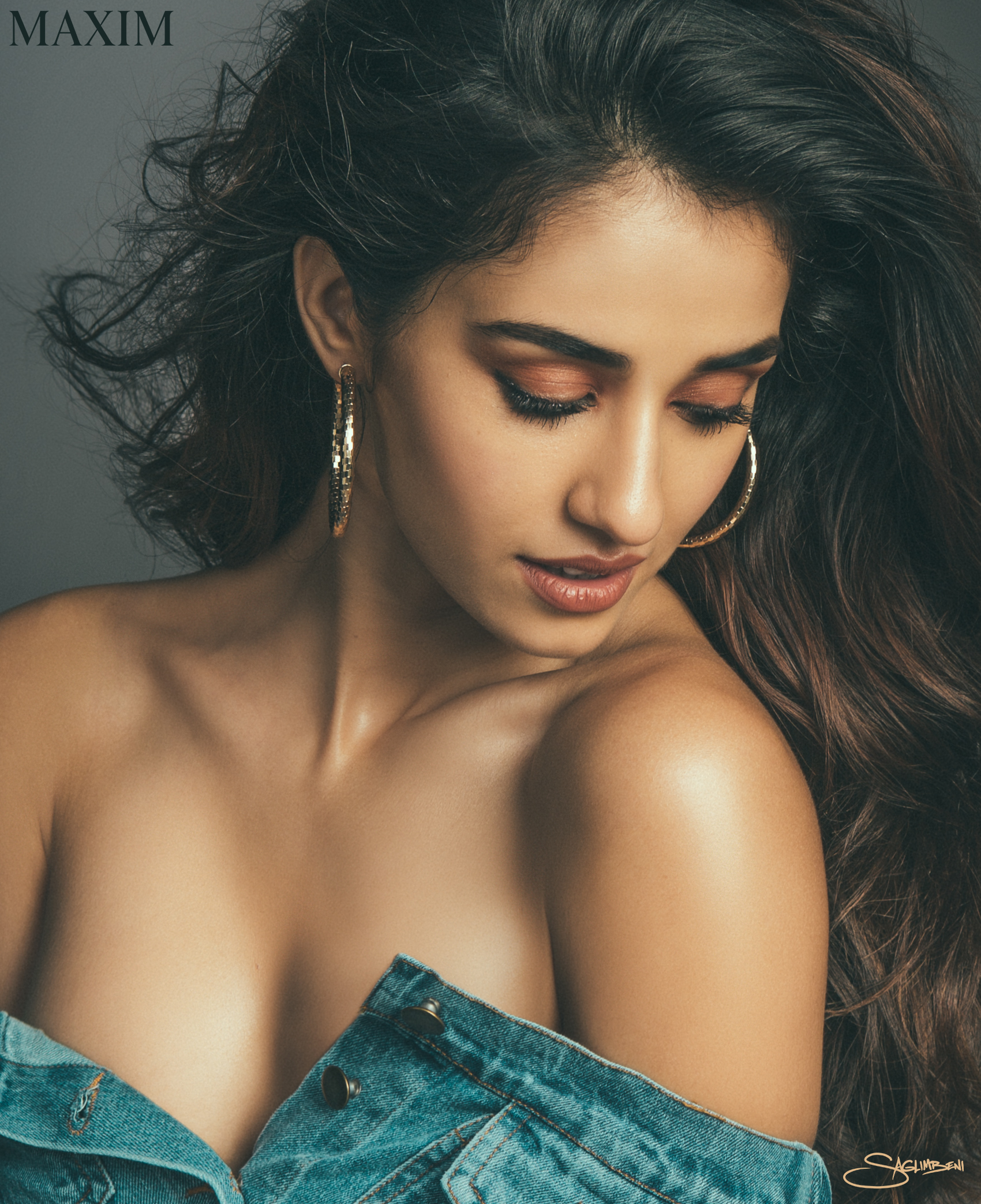
Photographing Actress Disha Patani for Maxim India

One of the most enjoyable aspects of photographing actors is the research stage. What’s more fun than watching movies to learn about your upcoming cover model? On the flight to Mumbai, I was happy to find the latest film starring Maxim India‘s November muse, actress Disha Patani, in Jackie Chan’s Kung Fu Yoga. Mr. Chan clearly has an eye for rising Bollywood talent, as he did when he cast Mallika Sherawat (who I photographed for Maxim India and WMB 3D) in The Myth more than a decade ago.
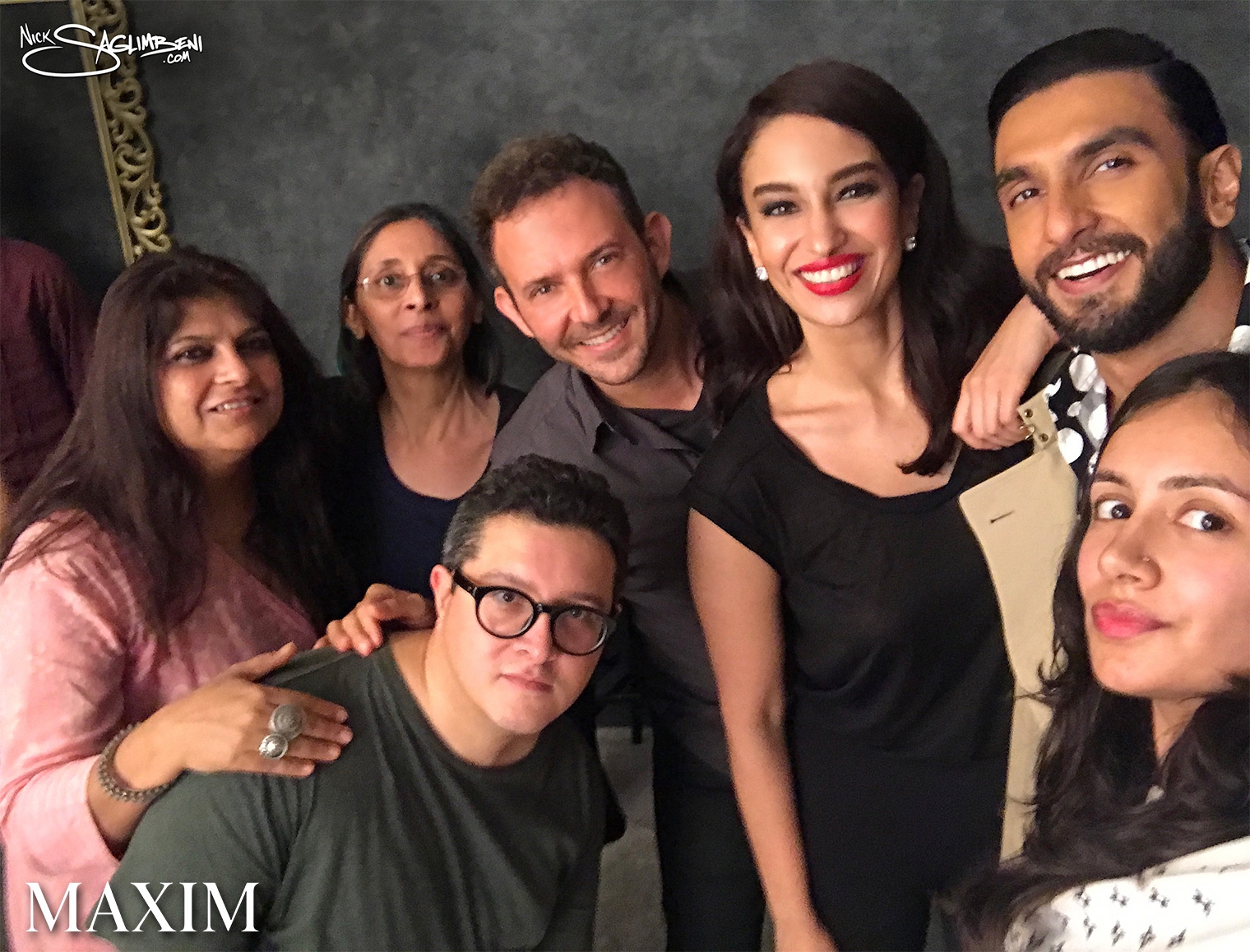
It’s easy to see why audiences fall for Disha. Her infectious signature smile is complemented by a sweet, sincere personality that would thaw even the uncharmable. We captured the cover shoot at Mehboob Studio in Mumbai, where I also photographed actor Ranveer Singh. Hair stylist Marce Pedrozo and makeup artist Flavia Giuliodori created gorgeous glam, and Sukriti Grover pulled stylish and sexy wardrobe.
Thanks to everyone on the team who helped create a beautiful feature. See my shoot with Disha in Maxim India‘s November issue, on stands now. Behind-the-scenes images below.
DISHA PATANI
Photography: NICK SAGLIMBENI
Hair: MARCE PEDROZO
Makeup: FLAVIA GIULIODORI
Styling: SUKRITI GROVER
Production Crew: IMRAN KHATRI PRODUCTIONS
BTS Stills & Video: RISHI KHARE


Photographing Actor Ranveer Singh for Maxim India
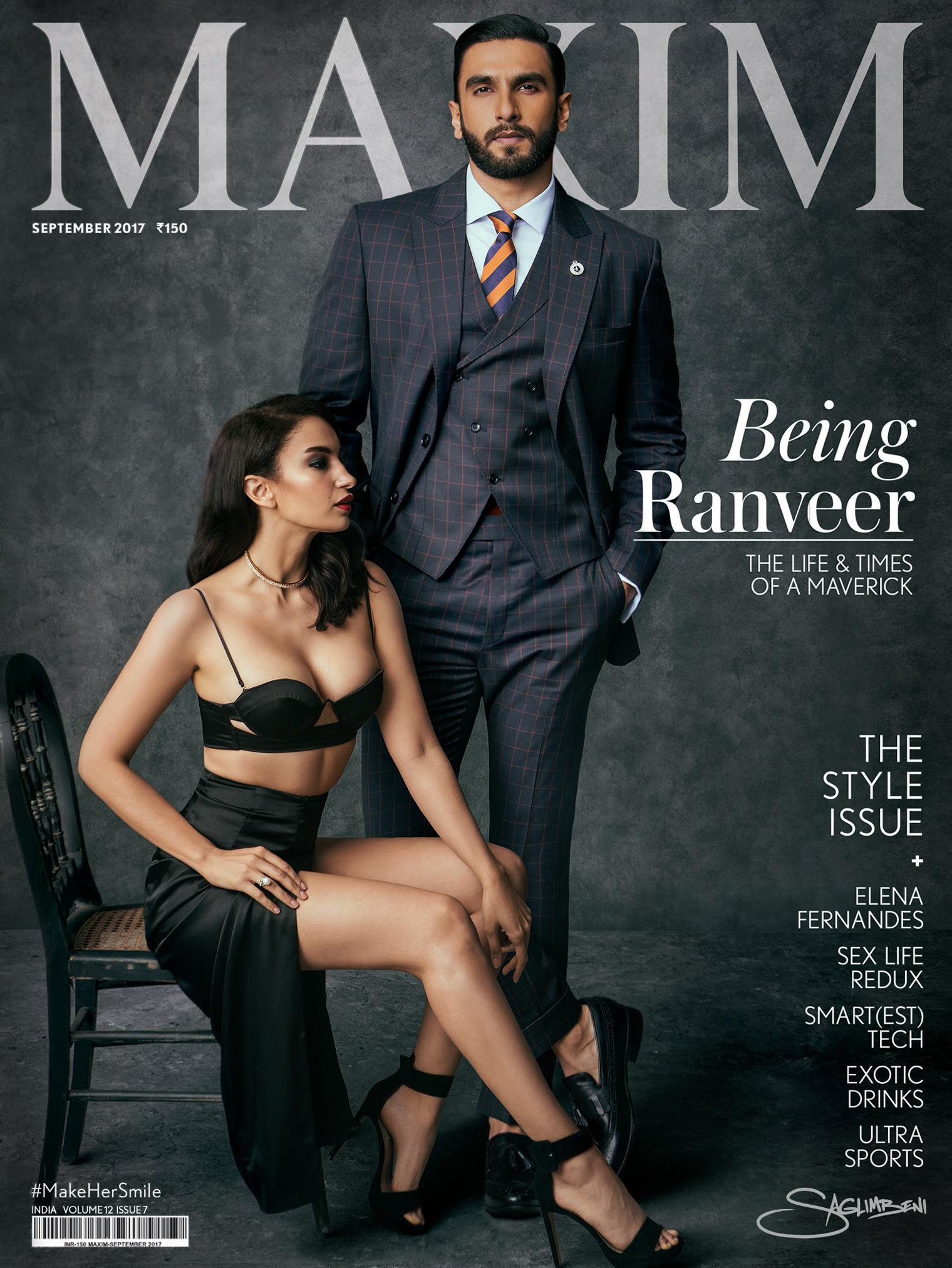
This August, I returned to Mumbai for a series of editorial shoots, the first of which hit stands this week. Bollywood mega-star Ranveer Singh graces the September cover of Maxim India, seen above with the beautiful Elena Fernandes. The posh pair model the latest styles in a sprawling 14-page fashion feature.
Ranveer was a lot of fun to work with, a total ball of energy who had the entire crew smiling and laughing. We photographed the shoot at Mehboob Studio in Bandra West, with many talented crew returning from my previous India shoots—including wardrobe stylist Nikita Jaisinghani (see our Rana Daggubati cover), and makeup artist Amelia Daswani, who glammed Shibani Dandekar for me and Maxim in March 2017.
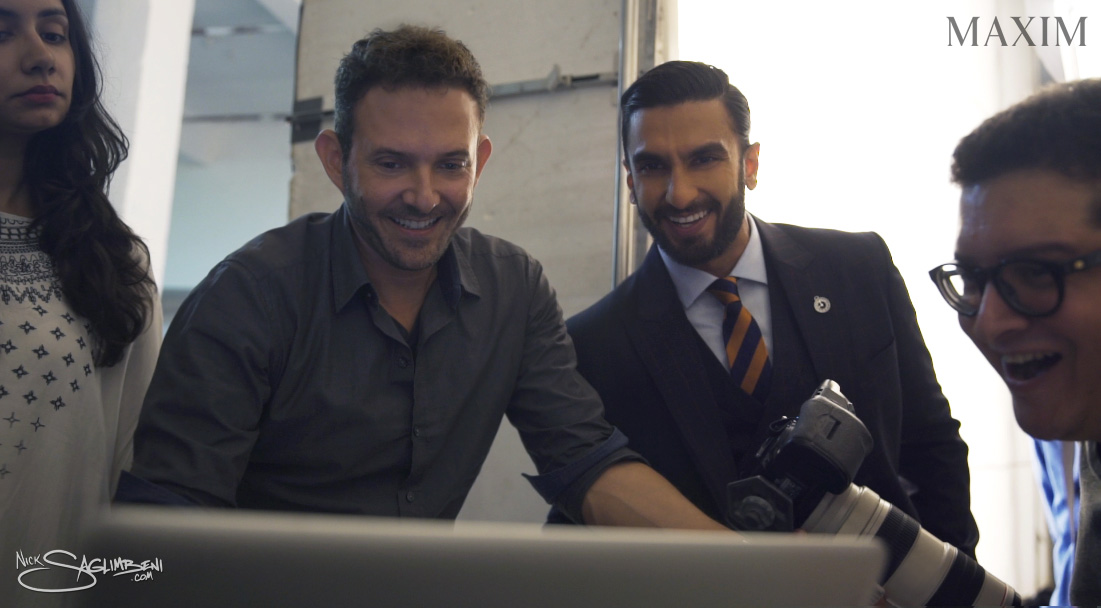
Thanks to the incredible team that helped create such a memorable shoot! Behind-the-scenes images below.
CREDITS:
Talent: RANVEER SINGH & ELENA FERNANDES
Photography: NICK SAGLIMBENI
Stylist: NIKITA JAISINGHANI
Ranveer’s Makeup: MAHADEV NAIK
Ranveer’s Hair: DARSHAN YEWALEKAR
Elena’s Hair & Makeup (Elena): AMELIA DASWANI
Ranveer’s Suits Provided by: THE ARVIND STORE
Production Crew: IMRAN KHATRI PRODUCTIONS
BTS Stills & Video: RISHI KHARE
 |
 |
The feature as published
Maxim India, September 2017. Cover and fourteen-page feature, “Into the Mind of the Stylish Man,” pages 48–61. Interview by Vivek Pareek. Photographed by Nick Saglimbeni in Mumbai.

Pages 48–49

Pages 50–51

Pages 52–53

Pages 54–55

Pages 56–57

Pages 58–59

Pages 60–61
RANVEER SINGH
ELENA FERNANDES
Photography: NICK SAGLIMBENI
Styling: NIKITA JAISINGHANI
Hair (Ranveer): DARSHAN YEWALEKAR
Makeup (Ranveer): MAHADEV NAIK
Hair & Makeup (Elena): AMELIA DASWANI at TFM India
Production: IMRAN KHATRI PRODUCTIONS
Location: MEHBOOB STUDIO, MUMBAI
Article text
Pages 48–49
Into The Mind Of The Stylish Man
Presenting RANVEER SINGH like you’ve probably never seen him before.
by VIVEK PAREEK
photographs by NICK SAGLIMBENI
Fashion, p. 49 (this spread): Bespoke three-piece suit and shirt by The Arvind Store (p.o.r.); tie by Tommy Hilfiger ₹2,999; lapel pin by The Gentleman’s Community ₹1,500; shoes by Dune ₹8,999
Pages 50–51
Fashion, p. 50 (this page): Ranveer wears: Bespoke suit, textured vest and shirt by The Arvind Store (p.o.r.); pocket square by The Gentleman’s Community ₹1,200; shoes by Brune ₹6,999
Elena wears: Dress by Deme by Gabriella ₹13,500; shoes by Steve Madden ₹6,999
MUMBAI. AUGUST 2017. GREY, OVERCAST. The city moves as it does. I’m meeting Ranveer, a bona fide superstar, an ace performer and also a guy most guys can associate with. He’s a Maxim guy. A man’s man. We’ve all heard stories of how he’s wild. True. How he’s intense. Also true. But what we haven’t seen is the man who’s got his own battles to fight, a dude who has a philosophy of living and a guy who works to party. Get ready to meet that Ranveer.
Hi, Ranveer, we’re very happy to have you back again. Your last Maxim shoot created a lot of ripples.
Thank you for having me. Yeah, that was a really sexy shoot. It’s probably still my sexiest shoot.
But it’s been a while.
It has. I guess, in my head, Maxim only puts hot women on the cover, not men. So, it didn’t strike me. But then, when I bumped into you the other day, it sort of struck us: “Hey, listen, why aren’t we collaborating again?” I’m glad to be back.
Nobody captures the essence of what Maxim is about like you. How do you stay so active? I see you and I want to kill myself. I wake up dead, and you’ll probably die charged.
I don’t know, man. People ask me this all the time, and it’s made me think about it. I’ve realised that it’s just me! Even in school, I was that kid. Always up to mischief. And, now, what I see is a lust for life. I want to go out and I want to do things. I want to meet new people and have new experiences. I try and make the most of every day. That’s basically it. It’s a deeply ingrained thought—that my time on Earth is limited, so I have to do as much as I can. Plus, I am one of those lucky few who get to do what they love. That’s how I approach my work: I feel like these opportunities are blessings and I feel the need to justify all these opportunities. I think: “Man, how amazing is it that I had just one dream, that there was nothing else I ever wanted to do and, today, I’m able to do that.” Sometimes, the things that happen to me and around me are beyond my wildest imagination. And that generates a great amount of enthusiasm in me as well.
And this enthusiasm translates into your work. Do you think there’s a method that goes into it or does it come naturally?
I feel like each character I play has a different default energy. For example, in Lootera and Dil Dhadakne Do, I played characters who were introverted, and the energy of an introvert is very different. You could say that I am an extrovert by nature, for a large part of the day. But I do prep for each of the characters I play. I can’t just walk onto a film set and pretend to know what I’m going to do. I have to do my homework, at least two or three weeks to sort of “marinate” in a character; it’s during this period that I kind of identify the character’s energy. I have to tap into a different side of myself sometimes, so there’s not one rule book or one way of going about it. I stay alone in a room with my material, sometimes I’m just sitting with my thoughts. Sometimes I’m mouthing dialogue and sometimes I’m pacing around the room. It’s definitely an invaluable process. You know, when I interact with some of my colleagues, they find it amusing that I take out so much time to prep for a character, but I find once you do that homework, you’re free to improvise on-set, and you can add something to a scene, or add a layer to the character.
You’ve played people who actually existed and you’ve played fictional characters. Which is more difficult to play?
Definitely the historical characters, because there are certain parameters that you have to work within. Fictional characters come from the writing, from the director, so you have a little more leeway to add to them, to expand them, or to highlight certain aspects that you find will be more appealing, entertaining or significant in the characterisation. But with historical characters, you try to do things within those set parameters and still not feel restricted. The historical characters that I’ve played are ancient, so the information available about them is limited. You try and do the math, you know, you try and create a personality out of the information that is available to you—decisions they’ve made in their lives, things they’ve achieved, their reactions to certain situations. You add all that up and try and then humanise everything. That’s where the homework comes into play, too. It’s a huge responsibility to try and stay true to that life, because this is someone who’s lived and breathed and affected history.
Excellent point about it being a responsibility. The character you’re playing in Padmavati is known through history as all-dark. How difficult was it to get into that head-space?
If you look at the history of Indian cinema, you’ll find that every time leading men have gone to the extent of being bad, it’s always motivated by a supervillain. But, for the first time—at least to my knowledge—I’ve gone and played an all-black, proper villain. And having worked on this character, I’ve realised that I don’t judge people’s perspectives… this has to do with my evolution as a person as well. Even the worst people have a perspective. They have a belief and perhaps their life experiences or a natural predisposition causes them to be a certain way. Every villain believes that he is right. So, you have to align yourself with that point of view. You also have to wrap yourself around the fact that it was a different time. I was initially apprehensive about playing this character because I know the space in my mind and in my soul that I would have to tap into, in order to put an honest performance out there. And I was actually in a good head-space at that time. But I believe in the duality of the universe. If there’s good, there’s bad; if there’s light, there’s dark; if there’s black, there’s white. There is always a counter-force. I believe in the goodness of people, but I also believe every person has some bad in them. I had to explore my dark side, go back to feelings that made me want to act out. I was scared. In this game of smoke and mirrors that is filmmaking, you can get the opportunity to burn all that kachra (garbage) that’s inside you and come out a lighter, kinder, happier person. You can channel it for something good, for art.
Pull quote, p. 51: “Sometimes, the things that happen to me and around me are beyond my wildest imagination. And that generates a great amount of enthusiasm in me as well.”
Pages 52–53
Fashion, p. 52 (this spread): Shirt by Eton at The Collective ₹17,000; trousers by Kenzo at The Collective ₹20,000; shoes by Brune ₹6,999
Pages 54–55
Fashion, p. 54 (this page): Bespoke tuxedo and printed shirt by The Arvind Store (p.o.r.); tie by Tom Ford (p.o.r.); collar pin by SS Homme ₹3,500; pocket square by Canali (p.o.r.)
It must have been tough.
It was a very difficult character to play. I’m a people pleaser, admittedly, I like to spread cheer and laughter, I like to keep the atmosphere light—even if it means making stupid jokes and acting silly and crass. But when I became Alauddin Khilji for the movie, there’s no trace of that person. Some actors are that way, where the external starts to affect the internal. At some point during filming, everybody realised that at one point in the morning you’ll have Ranveer and the rest of the day will be Khilji. My whole energy changed. Which is good, because at least I know I’m doing an honest job in the film. But, yeah, I’m almost done now and I have to say what I told myself holds true to some extent. All the darkness has been lived out, it’s been addressed. It’s almost like therapy.
Okay, follow-up question: would you do it again?
Wow! Probably a bad time to ask me that. I think I’ll have to give this side of me a break. I didn’t realise the conviction it would take to play evil. It’s really unlikely that I will do this again… it’s hard living with this guy. But the good part is that the characters lined up for my next few movies are very different.
Speaking of different, one of the things that always gets me is the on-screen chemistry you and Govinda had in Kill Dil. And I know he’s one of your idols. How was it working with a guy like him?
It was very surreal to be on a film set with him. We started off with a scene where he was driving, so it was tough to be in character because every so often I would go, “Oh shit! It’s Govinda, I’m actually in a movie with Govinda!” The fanboy in me would keep coming out, and I would be like, “Shut up! Shut up! Do your job!” But I took it as an opportunity to learn, to observe how he does what he does. In fact, you’ve reminded me of something so special right now, it makes me emotional. He is a large part of the reason I was attracted to Hindi films, and it’s really one of the high points of my career. My fondest memories are sitting at the monitor and being regaled by stories of how he did his own stunts. He has some crazy stories.
The going joke in our office is the “Push Pa” joke. You know, the kind of humour boys engage in when it’s just boys. Is that your brand in real life?
Yeah, it’s really bad. The boys and me have the lowest common denominator, filthy brand of humour that only we find funny.
It’s the same with all boys, I think. But we both know women are always going to be greater than men. Where does that belief come from as far as you’re concerned?
It has got a lot to do with my upbringing. My mom is the centre of my universe, as is my second mother—my elder sister, who’s two years older. Growing up in an environment with strong women around me has shaped who I am. Even when I was a copywriter, my boss was a woman. My romantic liaisons have also been with really strong, independent women and that has a lot to do with it as well. I’m also in the line of work where I’m surrounded by women. Plus, having studied in the U.S., I have a deep sense of gender equality.
Maxim has more women staffers than male, and I guess that’s why we get anything done.
I completely agree. Women have that wonderful gift of taking the edge off of everything. I much prefer collaborating with women, as I find them to be a lot more patient, more accepting of new ideas. I prefer the female energy to the male energy. And they’re sensitive.
What are you like as the guy in charge? What talents or traits come out in you on a personal level when you’re the boss?
I think I want to be better. As the years go by and you build a brand for yourself, you find you’re the CEO of brand Ranveer, so you would like to improve. I have a temperament and my mind works so fast that, a lot of times, I’m edgy because someone is not able to keep up. I need a little bit of “expectation management.” At this point, I think that’s the answer. I can’t expect everybody to work at the speed of my decision-making. I’m not terrible, of course, and I think the good aspect of working with me is that you see a level of sincerity and commitment that is infectious. I would like to believe that I lead by example, and that I’m very hands-on and meticulous. And I’d like to believe that attitude is infectious. But there’s scope for improvement, and I’m aware of that.
You’ve mentioned brand Ranveer, so what would your tag line be?
I guess, “Whatever you want me to be.”
I have heard that you are hard on yourself. Seems like it when you say that.
I think it’s relative. For some reason, I always feel like I can do more, that I can give more, or I could be just that little bit better. But I make a conscious effort to try to be objective. I was very, very hard on myself in the initial years, though. I would put pressure on myself to deliver but I slowly started realising that it’s unnecessary. I wasn’t enjoying the process as much as I should. And, over a period of time, I’ve learned to enjoy the process. And I find that a much more peaceful way to be.
Let’s switch tracks a little bit. This is our Style Issue, and I have to ask what brings out this experimental side. Is it conscious or is it something that just evolved?
It’s been a journey. To be fair, I’ve always been experimental with my style, ever since school. I was known to be the first one to try something different—wearing baggy jeans, wearing chunky silver jewellery, colouring my hair, getting a Mohawk, piercing my ears. In fact, I was the first one to use styling gel in my hair and that caused such a furore. The guys around tended to make safer choices and they’d call me atrangi. It’s a tag I’ve carried since school. Even when I went to college, I found the same silhouette on legions of boys and girls, and it was amusing. Why would anybody wear the same blue jeans and a black North Face zip-up that every other person was wearing? Plus, I had to creatively put something together to make an impressive look because I couldn’t afford a black zip-up jacket. When you’re starting out in the movies, you’re vulnerable and seeking validation. The time when you’re famous but not really. When you’ve achieved something but it’s perhaps not significant enough. I was trying to not just dress, but speak and act in a way that I thought people expected of an up-and-coming actor in the mainstream movie business. I was trying to fill the mould of expectations. So if you see my first few public appearances, they are much safer and more in line with the trends. But that wasn’t really me.
Pull quote, p. 55: “I like that my style is an extension of my personality. And I’ve reached a point where I’m empowered enough to encourage other people to express themselves in the way they act, speak and even dress”
Pages 56–57
Fashion, p. 56 (this spread): Shirt by Love Moschino at The Collective ₹15,000; trousers by Tommy Hilfiger ₹8,999; trenchcoat by Burberry ₹1,35,000; shoes by Rosso Brunello ₹8,999
Pages 58–59
Fashion, p. 58 (this page): Bespoke suit, textured vest and shirt by The Arvind Store (p.o.r.); pocket square by The Gentleman’s Community ₹1,200; shoes by Brune ₹6,999
How did that change?
I had a life-changing phase when I had a very serious back injury that put me out of action for many months—and physical injuries really get me down. I was only on my third film, Lootera, and I was on bed-rest for two months. I was like, “Man, here I am, where I always wanted to be, but I may never be able to do everything mainstream actors are required to do. I can’t even stand on my two feet!” It was a very significant phase in my personal evolution. And, when I came out of it, I realised I was a little bit more in touch with myself, more self-sufficient, less seeking the validation of others. So I started dressing the way I wanted to dress. By that time, I’d grown facial hair and my hair was longer, which is my preferred way of how I want to look. And I had all the time in the world so I had ordered a bunch of stuff for myself. When I came out of that phase, I looked the way I wanted, and I was not trying to conform. I was just doing what I felt and I realised I was much happier that way. The feedback remained good and bad, like before. Some people are going to like and some people are going to dislike what you wear or do, so you’re better off doing what you want to do. I started having fun with it. I feel like people are too quick to judge the way I dress. It’s not always that my clothes are out of the ordinary. Eight out of 10 instances, I’m dressed very casually. It’s the one instance when I decide to amuse myself that tends to get noticed. It’s like the goalkeeper syndrome, you know, where the goalkeeper makes 20 saves and nobody notices, but the one time he screws up and suddenly the spotlight’s on him. I find it very weird when people say, “Oh, you’ve made it your thing now.” It’s absolutely not my thing. It’s something I do because I find it amusing and I do it for myself.
So, what is your sense of style, you think?
I appreciate designers who push boundaries, who come up with something unique. And it is those unique elements that I find appealing. For example, if I’m supposed to get ready for an event and there are 10 suits on a rack and there’s one that has some stand-out elements, I’m probably going to be attracted to that. It’s just my natural instinct. I like that my style is an extension of my personality. And I’ve reached a point where I’m empowered enough to encourage other people to express themselves in the way they act, speak and even dress. If you’re feeling something, I feel you should express it. And it really depends on my mood, since I’m not afraid to follow my instincts.
You’ve done a lot of those viral stunts. Do you like to surprise people?
Of course. My school friends will vouch for this. I’ve always had this sulemani keeda—that itch to be a mischief maker. I guess it’s a function of coming into my own. And as people see more of me, they discover that side more and more.
Do you think ladies find that attractive?
I really don’t care. As a gentleman, I know what I bring to the table in terms of my personality. I don’t believe I’m the most good-looking guy, in terms of the conventional idea. But I’m very secure with my masculinity. Like I said, I don’t fear being judged. These are things that fall into the realm of subjectivity. The content is the same, it’s just that the context is different. It’s a way of viewing something. Someone with a negative perspective will say, “Oh, he’s so brash and loud!” while others will say, “He’s so enthusiastic.” It’s a way of looking at things. I’ve learned to take the good with the bad.
You don’t seem like the kind of guy who, I would imagine, has a lot of fears. Do you?
It’s all about learning to live in the moment, to relish the process rather than worrying about the prize. I don’t get anxious about the future and I don’t dwell in the past. It’s a happier way of being. I feel like so much of our lives are just not in our control, it’s the ebb and flow of the universe that is responsible for so much of who we are and what happens to us. It’s funny you ask this because just yesterday, my mind drifted to whether I was taking my own talent and ability for granted. “What if I’m just not able to do what I’m supposed to do?” And a chill went through me. That’s damn scary! What if I wake up and I’ve lost the ability to perform? It’s still a very recent and nascent thought, so I’ll have to dwell on it and see what comes from it.
Not too much, I hope. To counter that, if you were to be a superhero, who’d you be?
Deadpool! I would be Deadpool! I don’t know, man, I just connect with him. There was this poll online about who should be Deadpool if it were made in India, and I had a unanimous win there. I guess there’s something about his brand of humour, his irreverence and his attitude.
Do you Google “Ranveer Singh”?
All the time. If there’s anybody in show business who tells you they don’t Google themselves, they’re lying.
What would you say to a regular, decent guy to make him believe he can be exactly who he wants to be?
I’d tell him happiness is a choice. And that he should only depend on himself for happiness and a feeling of fulfilment. Life is too short, and he should try and live in the moment as much as possible. There’s this quote, “The past is ashes, the future is wood, the only thing that burns is the present.” Someone has defined success as the magnitude of the beneficial footprint that you leave on society. I feel success is measured by how you’ve improved the lives of the people around you. As much as we are encouraged to succeed as individuals, those experiences mean nothing if we don’t share them. It all sounds very philosophical, but I believe you have only one life—that you know of—so live it to the maximum.
Pull quote, p. 59: “As much as we are encouraged to succeed as individuals, those experiences mean nothing if we don’t share them. I believe you have only one life—that you know of—so live it to the maximum”
Pages 60–61
Fashion, p. 61 (this spread): Ranveer wears: Shirt by Eton at The Collective ₹17,000; trousers by Kenzo at The Collective ₹20,000; shoes by Brune ₹6,999
Elena wears: Dress by Terrence Lobo ₹4,500; shoes by Dune ₹7,999; earrings by Shaze ₹1,790
Credit box, p. 61: MODEL ELENA FERNANDES
STYLING NIKITA JAISINGHANI
HAIR (RANVEER) DARSHAN YEWALEKAR
MAKE-UP (RANVEER) MAHADEV NAIK
HAIR & MAKE-UP (ELENA) AMELIA DASWANI AT TFM INDIA
PRODUCTION IMRAN KHATRI PRODUCTIONS
Shooting the Kylie Jenner Shop Summer Lineup

Kylie Jenner recently launched her latest product line on KylieJennerShop.com. We photographed the camouflage-themed collection last month in Hollywood, with Kylie playing her own e-com model. In sync with the creative direction of the shoot, her poses were perfectly mannequin-esque.
Knowing the KJ team was planning to run the lead image on a Santa Monica Blvd. billboard, I shot the campaign on my faithful Hasselblad 503CW and Leap Aptus-II series back—the first time I’ve used this camera since 2014.
Congrats to Kylie and her team on a successful launch that sold out the hottest items in mere minutes. See the entire collection here, and take a look at behind-the-scenes images below.
CREDITS:
Model: KYLIE JENNER
Photography: NICK SAGLIMBENI
Makeup: PATRICK TA
Hair: TOKYO STYLEZ


California Summer: Capturing Duke’s 50th Anniversary Campaign

One of our favorite international clients recently flew to LA to create a 50th anniversary campaign for Duke India‘s fashion brand. SlickforceStudio produced the “California Dreamin'” campaign, which was shot over two days.
Day One took place at our favorite playground in the Mojave desert, Ultimate Graveyard, where the models posed on vintage vehicles, climbed plane shells, and danced along the railroad tracks.
On Day Two, we set up shop at Point Dume in Malibu, making use of the sprawling horizon views, steep cliffs, and sandy beaches.
See the 60-second commercial above, and behind-the-scenes images below. Congrats to Duke India on 50 years of success!
MODELS: Celine Farach, Maryam Zolghadr, Federico Pedroni, Austin Moreno
PHOTOGRAPHY: Nick Saglimbeni
WARDROBE STYLIST: Katie Qian
MAKEUP & HAIR: Sherri Celis, Sunny An
VIDEOGRAPHY: Derrick Cohan
BTS IMAGES: Joyce Park for SlickforceStudio


 |
 |
 |
 |

Stunning Sri Lanka & Shooting Maxim India in Mumbai

Sunset at Weligama Bay © Nick Saglimbeni / Slickforce Inc.

Shibani Dandekar by Nick Saglimbeni for Maxim © Slickforce Inc.
I spent the majority of March overseas, shooting multiple features for Maxim India, and then visiting one of the places I’ve dreamed of exploring since I was a child—mystical Sri Lanka.
Working in India with the Maxim team was an unforgettable experience. 24 hours after I landed in Mumbai, I photographed Indian film superstar Rana Daggubati, of the Bollywood blockbuster Bahubali. The mega-shoot took place at Film City Goregaon (think Universal Studios in India, a massive backlot with every environment imaginable), where we shot the cover and fashion feature in a huge soundstage. Then we headed outdoors to capture a promotional Jeep Wrangler off-road adventure in the woods. A few days later, I photographed TV host and model Shibani Dandekar in a hypercolor editorial that had the Indian entertainment blogs buzzing over her beauty.
After our Maxim shoots, I ventured south to enchanting Sri Lanka. I traveled from Colombo to Galle via train, and then continued to the southern end of the island via tuk-tuk (motorized rickshaw, photo below) to visit the legendary beaches and do some whale-watching. The sunsets were among the best and most colorful I’ve ever seen, and the people incredibly friendly. The beautiful country exceeded my expectations, and I look forward to going back.
The April issue of Maxim India is on stands now. My thanks to publisher Vivek Pareek and his amazing team for hosting me on my Indian adventures. Behind-the-scenes photos and travelogue images below.
CREDITS:
Cover shoot – Rana Daggubati, with models Riya Ray and Carolina Nalerio
Stylist: Nikita Jaisinghani
Rana’s Groomer: Aalim Hakim
Hair & Makeup: Rashmi Shastri
Photographed by Nick Saglimbeni
Shibani Dandekar Shoot
Stylist: Chandni Bahri
Makeup: Amelia
Hair: Ayesha Mulla
Photographed at the JW Marriott Mumbai by Nick Saglimbeni
Film City BTS by Sana Chhabra
All other images © Nick Saglimbeni / Slickforce Inc.
 Shibani Dandekar for Maxim © Slickforce Inc. |
 Carolina Nalerio for Maxim © Slickforce Inc. |
 Rana Daggubati for Maxim / Jeep © Slickforce Inc. |
 Reviewing photos w/ Rana & Maxim publisher Vivek Pareek |
 Maxim India April Cover (color variant) by Nick Saglimbeni |
 Team Maxim India with Rana Daggubati |

Shooting the Maxim cover at Film City Goregaon, Mumbai
 My star model in Sri Lanka, two year-old Iruki |
 Sunset in Weligama, Sri Lanka |
 Colorful tuk-tuk in Colombo, Sri Lanka |
 Polwatta River in Weligama, Sri Lanka |

Crystal coast at Midigama, Sri Lanka © Nick Saglimbeni / Slickforce Inc.
Directing the “Conquer With Colosseum” Commercial
As many of you know, I’ve photographed the Colosseum athletic-wear catalog for several years. Earlier this summer, during our Spring 2017 look-book shoot, I directed their first commercial, shot at the historic Gamble House in Pasadena, CA. It was both fun and challenging to wear the director and photographer hats simultaneously, and I couldn’t have done it without the help of two amazing teams—Slickforce and Colosseum. Our leading ladies, Samaria and Kiki, brought energy and ethusiasm and made every frame beautiful. Special thanks to cinematographers Roger Viloria and Jason Leibsla for capturing such vibrant images.
Check out the final commercial above, and see behind-the-scenes from the production below. Be sure to #ConquerWithColosseum at their online store. Enjoy!
Starring SAMARIA REGALADO, KIKI MCCLEARY
Directed by NICK SAGLIMBENI
Produced by MARIA DONOGHUE
Cinematography by ROGER VILORIA & JASON LEIBSLA
Associate Producers JOYCE PARK, NICOLAS SANSONE, KEVIN SAVARESE
Production Stills by JOYCE PARK


Photographing Priyanka Chopra for Maxim India

Recently, I flew to New York to photograph actress Priyanka Chopra (ABC’s Quantico) for the July cover of Maxim India. It was my first time working with the Bollywood superstar and I was thrilled to find that she is as sweet and collaborative as she is gorgeous.
Ms. Chopra was voted the number one spot in Maxim’s Hot 100 tally of the most beautiful women in the world—the first three-time winner in the history of the publication. After working with her, there’s little wonder why.
Go behind-the-scenes of our cover shoot in the video below. My thanks to an incredible glam squad in NYC. More to come on this shoot as new images are released!
Photo by NICK SAGLIMBENI
Styled by KRISANA SOTELO for The Wall Group
Hair TED GIBSON
Makeup by STEPHANIE BARNES


Protecting Sharks with Jhené Aiko for The Humane Society


Those of you who follow my work know that creating art for important causes has always been critical to the SlickforceStudio mission. So it is with great pleasure that we recently teamed up with The Humane Society of the United States and HS International for their latest campaign, featuring singer/songwriter Jhené Aiko.
Ms. Aiko is very passionate about animals and nature—and all things aquatic—so she was the perfect face for HSUS’ new campaign to stop inhumane shark hunting. Tens of millions of sharks are killed each year due to the demand of shark fin soup. Humane Society Campaign manager Amber Morasse wanted a concept that was as striking as it was effective. We discussed several ideas before finally settling on a dramatic night ocean scene with Jhené rising above the surface of the water like a shark.
Besides the obvious risks to talent, shooting in an actual ocean isn’t terribly practical. There’s nowhere to place backlights and you’re certainly not going to run electricity in the deep blue sea. So we opted for a much more controlled environment: a large swimming pool. As you’ll see in the behind-the-scenes video below, our first challenge was turning a bright daylight location into a night scene. The second was getting the lights and camera into the water.
It was a pleasure working with Jhené, and I applaud her for using her celebrity to spread awareness of these wonderful creatures’ plight. I want to thank Amber and The Humane Society for involving us in this important project, and the SlickforceStudio team for getting wet for a good cause.
Visit hsi.org to find out how you can help.
WARNING: This setup was achieved by trained professionals. Do not attempt to bring lights near water without proper electrical safety training.
[bg_faq_start]
(Click here for further info about safely working around water.)
As many of you know, I was a cinematographer and a gaffer for several years before moving into professional photography. Movie lights draw an extremely high current (measured in Amps) due to their size and light output—and electrocution is a very real concern. As a result, my team and I have been through rigorous electrical-safety training throughout the years. We also teach electrical safety at our PhotoKamp workshops.
To be clear, there is always a risk when mixing electricity and water . It doesn’t have to be a water concept, it could simply start raining on your outdoor shoot. You can see in our setup that we had a single light “in” the pool. The other lights were safely placed (and heavily sand-bagged) on dry land. The light that I brought into the pool was on a sturdy C-stand, ratcheted down tightly, with about 120 lbs. of sandbags on it, both on the base and higher to distribute the weight evenly. The feeder cable was then looped around the stand arm and run up through the frame of the overhead silk, then dropped down to the ballast on dry land, well away from the water. The 1200w/s Profoto ballast was then plugged into a surge protector, which was itself plugged into a pool-safe GFCI outlet (the same ones used for underwater pool lighting fixtures). You can read more about ground-fault interrupters around swimming pools here: http://blog.poolcenter.com/article.aspx?articleid=6065 On top of these multiple layers of protection, you’ll notice we kept slack on the cable (some may have wondered why we didn’t pull it tighter). This prevents cable tension and decreases the risk of the light being knocked over should someone bump into it. We also have this area roped off and continuously manned to minimize human error.
My team and I take electrical safety extremely seriously, and you should never take a chance until you’ve been trained by an expert. Any misjudgments are most certainly errors that you only get to make once. Safety above all else![bg_faq_end]
CREDITS:
Model: Jhené Aiko
Photographer: Nick Saglimbeni
Makeup: Felicia La Tour
Production Stills: Joyce Park & Joey Valenti
Videography: Joey Valenti & Ludovica Isidori
 |
 |
 |
 |
 |
 |